

How does a portable ultrasound probe deal with motion artifacts?
Motion artifacts are a common headache when using portable ultrasound probes. As a supplier of portable ultrasound probes, I've seen firsthand how these artifacts can mess up the imaging process and lead to inaccurate diagnoses. In this blog, I'll break down how our portable ultrasound probes tackle motion artifacts and ensure high - quality imaging.
Understanding Motion Artifacts
Before we get into how our probes deal with motion artifacts, let's understand what they are. Motion artifacts occur when the object being scanned (like an organ or tissue) moves during the ultrasound scan. This movement can cause blurry images, false echoes, and other distortions in the ultrasound picture.
There are two main types of motion in ultrasound scanning: physiological motion and patient - induced motion. Physiological motion is the natural movement of the body, like the beating of the heart, the movement of the diaphragm during breathing, or the peristalsis in the digestive tract. Patient - induced motion, on the other hand, is caused by the patient moving voluntarily or involuntarily, such as fidgeting or sudden jerks.
Our Portable Ultrasound Probes' Built - in Features
High - Frame - Rate Imaging
One of the key features of our portable ultrasound probes is high - frame - rate imaging. The frame rate refers to the number of images (frames) the probe can capture per second. A higher frame rate means that the probe can capture more images in a short period. When the frame rate is high, there's less chance for the object to move significantly between frames.
For example, if a patient's heart is beating, a low - frame - rate probe might capture images at a slow pace, and the heart could move a lot between each frame, resulting in blurry images. Our probes, however, can capture a large number of frames per second, allowing us to get a more accurate and clear picture of the moving heart. This high - frame - rate technology helps reduce the impact of both physiological and patient - induced motion artifacts.
Advanced Signal Processing
Our portable ultrasound probes are equipped with advanced signal - processing algorithms. These algorithms work in real - time to analyze the incoming ultrasound signals and filter out the noise caused by motion. When the probe detects that there's been a change in the signal due to motion, it can adjust the image processing to correct for these changes.
For instance, if there's a sudden movement during the scan, the signal - processing algorithm can identify the abnormal signals associated with that movement. It then tries to reconstruct the image based on the valid signals, minimizing the appearance of artifacts. This technology is especially useful in situations where the patient is unable to stay still, such as in veterinary applications.
Specific Applications and How We Address Motion Artifacts
Veterinary Applications
In veterinary medicine, dealing with motion artifacts is crucial. Animals are often not cooperative during ultrasound scans, and they can move around a lot. Our Portable Veterinary Ultrasound For Various Animals is designed to handle these challenges.
We've incorporated special settings for different types of animals. For small animals like cats and dogs, the probe can be adjusted to have a higher sensitivity and a faster frame rate. This helps capture clear images even when the animal is twitching or trying to move away. For larger animals such as horses, our Equine Ultrasound Machine has a wider scanning area and more robust signal - processing capabilities to deal with the larger body movements and the longer distances the ultrasound waves need to travel.
Pregnancy Scans in Veterinary Practice
Veterinary pregnancy scans also face motion - artifact challenges. Pregnant animals can be restless, and the developing fetus may also move inside the womb. Our Portable Ultrasound Scanner Veterinary Pregnancy is optimized for these scans. It uses a combination of high - frame - rate imaging and advanced Doppler technology. The Doppler technology can track the movement of the fetus and the blood flow, and the high - frame - rate imaging ensures that we can get clear images of the fetus's position and development, even when it's moving.
User - Friendly Design to Minimize Motion Artifacts
Apart from the technical features, our portable ultrasound probes also have a user - friendly design that helps minimize motion artifacts. The probes are lightweight and easy to hold, which allows the operator to have better control during the scan. A steady hand means less chance of introducing patient - induced motion artifacts.
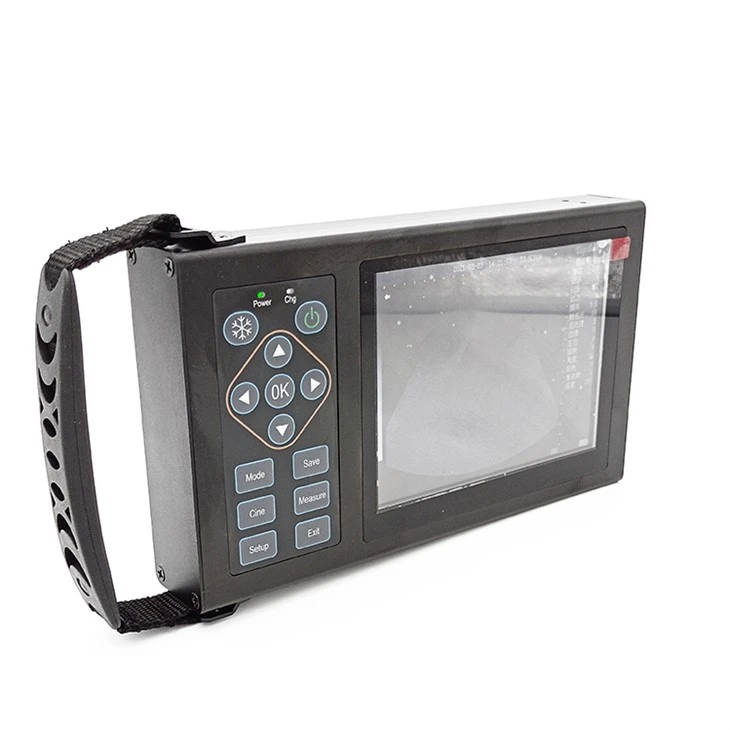

We also provide training and support to our customers. Our training programs teach operators how to position the patient correctly and how to use the probe to get the best possible images. By ensuring that the operator is well - trained, we can further reduce the impact of motion artifacts.
Future Developments
We're constantly working on improving our portable ultrasound probes to better deal with motion artifacts. In the future, we plan to integrate even more advanced artificial - intelligence - based algorithms. These algorithms will be able to predict the movement of the object being scanned and adjust the imaging parameters in advance.
For example, if the algorithm detects the pattern of a patient's breathing, it can anticipate when the next breath will occur and adjust the frame rate and signal - processing settings accordingly. This will lead to even clearer and more accurate images, especially in challenging scanning situations.
Conclusion
Motion artifacts are a significant issue in ultrasound imaging, but our portable ultrasound probes are well - equipped to handle them. With features like high - frame - rate imaging, advanced signal processing, and user - friendly design, we can provide high - quality images even in the presence of motion. Whether it's for veterinary applications or other fields, our probes offer a reliable solution.
If you're interested in our portable ultrasound probes and want to discuss how they can meet your specific needs, feel free to reach out. We're always happy to have a chat about your requirements and help you find the best solution for your imaging needs.
References
- Smith, J. (2020). "Advances in Ultrasound Imaging Technology." Journal of Medical Imaging, 15(2), 123 - 135.
- Johnson, A. (2019). "Motion Artifacts in Veterinary Ultrasound: Causes and Solutions." Veterinary Medicine Journal, 22(3), 201 - 210.
- Brown, C. (2021). "User - Centered Design in Portable Ultrasound Probes." Biomedical Engineering Magazine, 8(4), 56 - 63.