

How does a portable ultrasound probe work with different transducer types?
Hey there! As a supplier of portable ultrasound probes, I'm super excited to dig into how these nifty gadgets work, especially when it comes to different transducer types. So, let's jump right in!
First off, what's a portable ultrasound probe? Well, it's a compact device that uses ultrasound technology to create images of the inside of the body. It's like having a mini - hospital in your hands. These probes are used in a variety of settings, from veterinary clinics to small medical offices, and even in some home healthcare situations. And the best part? They're easy to carry around, which makes them super convenient.
Now, let's talk about the star of the show: the transducer. A transducer is the part of the ultrasound probe that sends out ultrasound waves and receives the echoes. There are several different types of transducers, and each one has its own unique features and uses.
Piezoelectric Transducers
The most common type of transducer used in portable ultrasound probes is the piezoelectric transducer. These transducers are made from special materials that can convert electrical energy into mechanical energy (ultrasound waves) and vice versa. When an electrical current is applied to the piezoelectric material, it vibrates, creating ultrasound waves. When these waves bounce off internal structures in the body and return as echoes, the piezoelectric material converts the mechanical energy of the echoes back into electrical signals. These signals are then processed by the ultrasound machine to create an image.
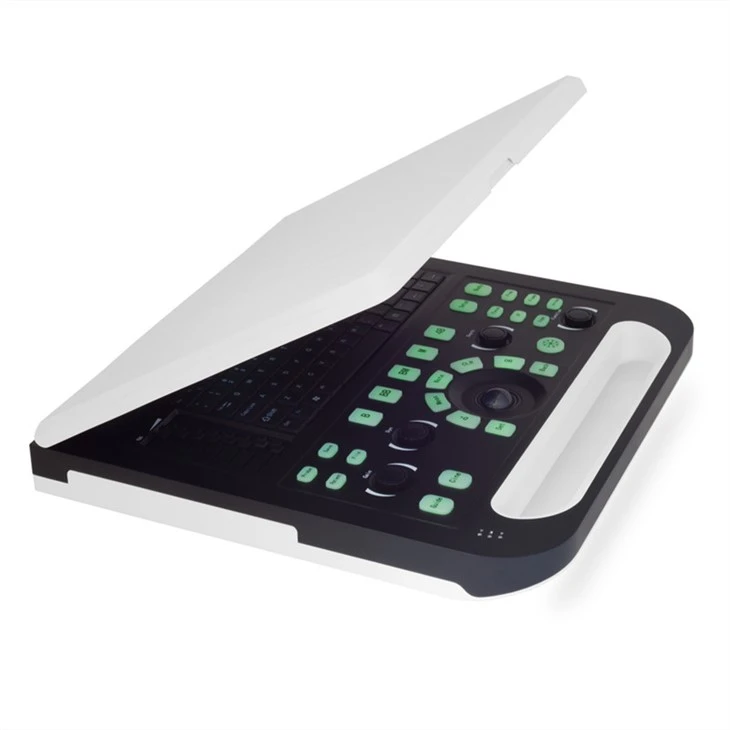
Piezoelectric transducers are great because they're efficient and reliable. They can produce high - frequency ultrasound waves, which are ideal for imaging small structures close to the surface of the body, like tendons and muscles. If you're looking for a Portable Laptop Ultrasound Machine, chances are it's using a piezoelectric transducer.
Capacitive Micromachined Ultrasonic Transducers (CMUTs)
Another type of transducer that's gaining popularity is the capacitive micromachined ultrasonic transducer, or CMUT for short. CMUTs are made using microfabrication techniques, which allow for a high level of integration and miniaturization.
These transducers work based on the principle of capacitance. They consist of a flexible membrane suspended over a cavity. When an electrical voltage is applied, the membrane moves, creating ultrasound waves. When the echoes return, the movement of the membrane changes the capacitance, which is then detected and converted into an electrical signal.
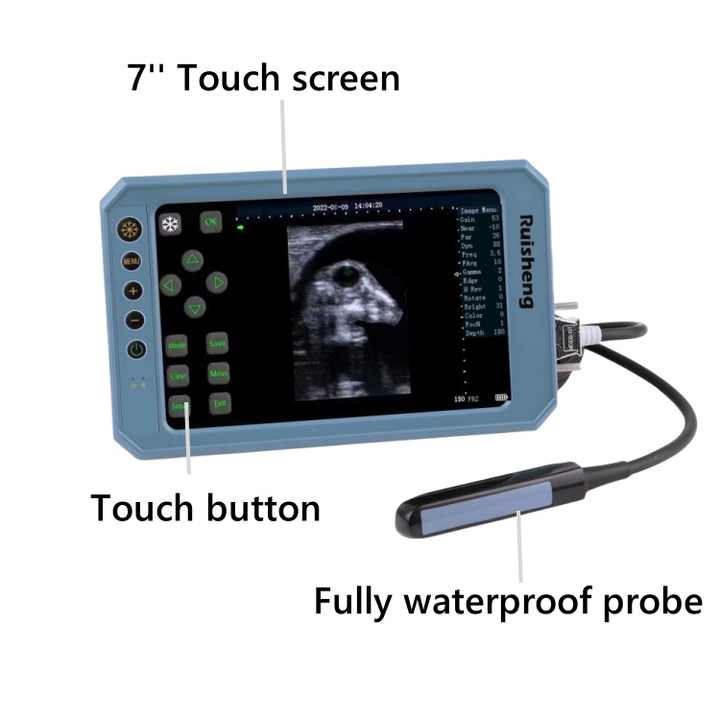
CMUTs have some advantages over piezoelectric transducers. They can operate over a wider frequency range, which means they can be used for both shallow and deep imaging. They also have better sensitivity and can produce higher - quality images. If you're in the market for a Handheld Veterinary Ultrasound, a CMUT - based probe might be a great option.
Linear Array Transducers
Linear array transducers are a type of transducer arrangement. They consist of a series of small transducer elements arranged in a straight line. When these elements are activated in sequence, they produce a rectangular - shaped ultrasound beam.
Linear array transducers are commonly used for imaging superficial structures, such as blood vessels and the thyroid gland. They provide a wide field of view and high - resolution images. The advantage of using a linear array transducer in a portable ultrasound probe is that it can quickly and accurately image large areas close to the surface of the body.
Curvilinear Array Transducers
Curvilinear array transducers, on the other hand, have the transducer elements arranged in a curved line. This arrangement allows for a wider field of view at greater depths compared to linear array transducers.
These transducers are often used for abdominal and pelvic imaging. They can penetrate deeper into the body and provide a more comprehensive view of internal organs. If you're a veterinarian using a Mobile Vet Ultrasound to examine a large animal, a curvilinear array transducer can be very useful.
Phased Array Transducers
Phased array transducers are a bit more complex. They also consist of multiple transducer elements, but these elements can be electronically controlled to steer and focus the ultrasound beam.
Phased array transducers are commonly used for cardiac imaging. They can be used to image the heart from different angles without having to physically move the probe. This is especially useful in a portable setting, where it might be difficult to reposition the patient.
How the Probe Works with Different Transducers
Now that we've covered the different types of transducers, let's talk about how the portable ultrasound probe works with them. When you turn on the probe, the control unit sends electrical signals to the transducer. The type of signal depends on the type of transducer and the imaging mode you've selected.
For example, if you're using a piezoelectric transducer in B - mode (brightness mode), which is the most common imaging mode, the control unit sends a series of short electrical pulses to the transducer. The transducer then emits ultrasound waves into the body. As the waves bounce off internal structures and return as echoes, the transducer converts these echoes into electrical signals. These signals are sent back to the control unit, which processes them and displays an image on the screen.
If you're using a phased array transducer, the control unit can adjust the timing of the electrical signals sent to each element to steer and focus the ultrasound beam. This allows you to get a clear image of the target structure from different angles.
Advantages of Portable Ultrasound Probes with Different Transducers
One of the biggest advantages of portable ultrasound probes is their versatility. With different types of transducers, you can use the same probe for a variety of applications. For example, you can use a linear array transducer for superficial imaging and then switch to a curvilinear array transducer for deeper abdominal imaging.
Portable ultrasound probes are also cost - effective. They're much cheaper than traditional large - scale ultrasound machines, which makes them accessible to small clinics and veterinarians. And because they're portable, you can take them to the patient's bedside or out to the field, which is a huge advantage in emergency situations.
Contact Us for Your Portable Ultrasound Probe Needs
If you're in the market for a portable ultrasound probe, we've got you covered. We offer a wide range of probes with different transducer types to meet your specific needs. Whether you're a veterinarian, a medical professional, or someone in the home healthcare industry, we can help you find the perfect probe for your application.
Don't hesitate to reach out to us to discuss your requirements. We're here to answer all your questions and help you make an informed decision. Let's work together to bring the benefits of portable ultrasound technology to your practice.
References
- Bushberg, J. T., Seibert, J. A., Leidholdt, E. M., & Boone, J. M. (2011). The essential physics of medical imaging. Lippincott Williams & Wilkins.
- Hendee, W. R., & Ritenour, E. R. (2002). Medical imaging physics. Wiley - Liss.
- Wang, T., & Shung, K. K. (2009). Ultrasonic transducers for medical imaging. Springer Science & Business Media.