

What is the axial resolution of a handheld ultrasound probe?
Axial resolution is a fundamental concept in the field of ultrasound imaging, and it plays a crucial role in determining the quality and diagnostic value of the images produced by handheld ultrasound probes. As a leading supplier of handheld ultrasound probes, we understand the significance of axial resolution and its impact on the performance of our products. In this blog post, we will delve into the details of axial resolution, exploring what it is, how it is measured, and why it matters in the context of handheld ultrasound probes.
Understanding Axial Resolution
Axial resolution refers to the ability of an ultrasound system to distinguish between two closely spaced objects along the direction of the ultrasound beam. In simpler terms, it is the minimum distance between two reflectors that can be resolved as separate entities in an ultrasound image. The axial resolution is determined by the wavelength of the ultrasound wave and the bandwidth of the ultrasound pulse.
The wavelength of an ultrasound wave is inversely proportional to its frequency. Higher frequency ultrasound waves have shorter wavelengths, which allow for better axial resolution. However, higher frequency waves also have a shorter penetration depth, which means they are more suitable for imaging superficial structures. On the other hand, lower frequency waves have longer wavelengths and a greater penetration depth, but they offer lower axial resolution.
The bandwidth of an ultrasound pulse is the range of frequencies contained within the pulse. A wider bandwidth allows for a shorter pulse length, which improves the axial resolution. This is because a shorter pulse can more accurately distinguish between two closely spaced reflectors.

Measuring Axial Resolution
Axial resolution is typically measured in millimeters (mm) and is often expressed as the full width at half maximum (FWHM) of the ultrasound pulse. The FWHM is the width of the pulse at half of its maximum amplitude. A smaller FWHM indicates better axial resolution.
To measure the axial resolution of a handheld ultrasound probe, a test object with known reflectors at a specific distance apart is used. The ultrasound probe is then used to image the test object, and the axial resolution is determined by measuring the minimum distance between two reflectors that can be clearly distinguished in the image.
Importance of Axial Resolution in Handheld Ultrasound Probes
Axial resolution is of utmost importance in handheld ultrasound probes for several reasons. Firstly, it directly affects the image quality. A higher axial resolution allows for the visualization of smaller and more closely spaced structures, which can provide more detailed and accurate diagnostic information. This is particularly important in applications such as obstetrics, where the ability to visualize the fetus and its internal organs is crucial for detecting any potential abnormalities.
Secondly, axial resolution impacts the diagnostic accuracy of the ultrasound examination. By being able to distinguish between two closely spaced structures, healthcare professionals can make more precise diagnoses and develop appropriate treatment plans. For example, in cardiology, a high axial resolution can help in the detection of small cardiac lesions or the assessment of valve function.
Thirdly, axial resolution is essential for guiding minimally invasive procedures. Handheld ultrasound probes are often used during procedures such as biopsies or injections to provide real-time imaging guidance. A high axial resolution ensures that the needle or other instruments can be accurately placed within the target structure, reducing the risk of complications and improving the success rate of the procedure.
Factors Affecting Axial Resolution in Handheld Ultrasound Probes
Several factors can affect the axial resolution of handheld ultrasound probes. One of the most significant factors is the frequency of the ultrasound wave. As mentioned earlier, higher frequency waves offer better axial resolution but have a shorter penetration depth. Therefore, the choice of frequency depends on the specific application and the depth of the structures to be imaged.
Another factor is the design and construction of the ultrasound probe. The quality of the transducer elements, the electronics, and the signal processing algorithms can all impact the axial resolution. At our company, we invest heavily in research and development to ensure that our handheld ultrasound probes are equipped with the latest technology and high-quality components to achieve the best possible axial resolution.
The operating conditions also play a role in axial resolution. Factors such as the patient's body habitus, the presence of air or bone in the imaging path, and the operator's technique can all affect the quality of the ultrasound image and, consequently, the axial resolution.
Our Handheld Ultrasound Probes and Axial Resolution
As a leading supplier of handheld ultrasound probes, we are committed to providing our customers with products that offer excellent axial resolution. Our probes are designed with the latest technology and high-quality materials to ensure optimal performance.
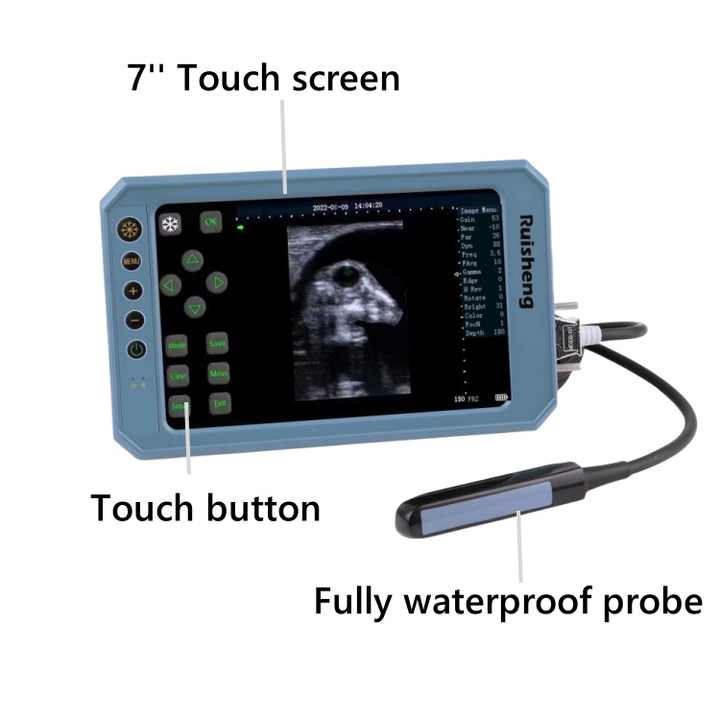
We offer a wide range of handheld ultrasound probes with different frequencies and configurations to meet the diverse needs of our customers. Whether you are a veterinarian in need of Veterinary Ultrasound Probes for animal imaging, a cardiologist looking for a high-resolution probe for cardiac examinations, or a general practitioner in need of a versatile probe for a variety of applications, we have the right solution for you.
Our Equine Ultrasound Machine is specifically designed for equine imaging and offers a high axial resolution to accurately visualize the horse's internal organs and detect any potential health issues. Similarly, our Mobile Vet Ultrasound systems are portable and easy to use, making them ideal for on-site veterinary examinations.
Conclusion
In conclusion, axial resolution is a critical parameter in handheld ultrasound probes that directly affects the image quality, diagnostic accuracy, and the ability to guide minimally invasive procedures. As a supplier of handheld ultrasound probes, we understand the importance of axial resolution and strive to provide our customers with products that offer the best possible performance.
If you are interested in learning more about our handheld ultrasound probes or would like to discuss your specific requirements, please feel free to contact us. Our team of experts is always ready to assist you in finding the right solution for your needs. We look forward to the opportunity to work with you and help you achieve better diagnostic outcomes.
References
- Kremkau FW. Diagnostic Ultrasound: Principles, Instruments, and Exercises. 5th ed. Philadelphia: Saunders Elsevier; 2006.
- Bushberg JT, Seibert JA, Leidholdt EM Jr, Boone JM. The Essential Physics of Medical Imaging. 3rd ed. Philadelphia: Lippincott Williams & Wilkins; 2012.
- Waag RC, Baker JC, Cha J. Physical Principles of Ultrasound. In: Bushberg JT, Seibert JA, Leidholdt EM Jr, Boone JM, eds. The Essential Physics of Medical Imaging. 3rd ed. Philadelphia: Lippincott Williams & Wilkins; 2012:407-437.