

What is the power consumption of a portable ultrasound probe?
Portable ultrasound probes have revolutionized the field of medical and veterinary diagnostics, offering convenience and flexibility in a wide range of settings. As a leading supplier of portable ultrasound probes, we often receive inquiries about the power consumption of these devices. Understanding power consumption is crucial for users who need to operate the probes in various environments, especially where power sources may be limited or unreliable. In this blog post, we will delve into the factors that influence the power consumption of portable ultrasound probes and provide insights to help you make informed decisions.
Factors Affecting Power Consumption
Probe Design and Technology
The design and technology of a portable ultrasound probe play a significant role in determining its power consumption. Modern probes are engineered to be energy - efficient, utilizing advanced integrated circuits and low - power components. For instance, probes with a phased - array design may consume more power compared to linear or convex array probes due to the complexity of their beam - forming technology. Phased - array probes can steer and focus the ultrasound beam electronically, which requires more computational power and, consequently, more energy.
Frequency and Imaging Mode
The frequency at which the ultrasound probe operates and the imaging mode selected also impact power consumption. Higher - frequency probes generally consume more power because they require more energy to generate the shorter - wavelength ultrasound waves. Different imaging modes, such as B - mode (brightness mode), M - mode (motion mode), and Doppler mode, have varying power requirements. Doppler mode, which is used to measure blood flow, typically consumes more power than B - mode because it involves additional signal processing to analyze the frequency shifts of the reflected ultrasound waves.
Display and User Interface
If the portable ultrasound probe is integrated with a display and user interface, these components contribute to the overall power consumption. Larger, high - resolution displays require more power to illuminate and render images. Additionally, touch - screen interfaces and other interactive features can increase energy usage. Some portable probes are designed with energy - saving features, such as automatic screen dimming or sleep modes, to reduce power consumption when the device is not in active use.
Measuring Power Consumption
The power consumption of a portable ultrasound probe is typically measured in watts (W). This measurement indicates the rate at which the device uses electrical energy. To accurately measure the power consumption, one can use a power meter, which is a device that can be connected between the probe and its power source. By monitoring the power consumption over a period of time, users can estimate the battery life of the probe when operating on battery power or calculate the electricity cost when using an AC power source.
Most portable ultrasound probes have a power consumption range that depends on the factors mentioned above. On average, a basic portable ultrasound probe may consume between 5 to 15 watts during normal operation. However, more advanced probes with additional features and higher - performance capabilities can consume up to 30 watts or more.
Implications for Users
Battery Life
For users who rely on battery - powered portable ultrasound probes, understanding power consumption is essential for planning and ensuring uninterrupted operation. A probe with lower power consumption will have a longer battery life, allowing for extended use in the field or in areas without access to a reliable power grid. For example, in veterinary medicine, a veterinarian may need to use a Handheld Veterinary Ultrasound during farm visits or in remote locations. A probe with good battery life can be a valuable asset in such situations.
Power Source Requirements
In addition to battery life, the power consumption of the probe determines the type of power source required. If the probe has high power consumption, it may need to be connected to a high - capacity battery or an AC power source. This can limit the portability of the device in some cases. On the other hand, low - power probes can be more versatile and can be powered by smaller, more portable batteries or even USB power sources.
Our Solutions as a Supplier
As a supplier of portable ultrasound probes, we are committed to providing products with optimal power consumption. Our Veterinary Ultrasound Probes are designed with energy - efficient technologies to ensure long battery life and reliable performance. We offer a range of probes with different frequencies, imaging modes, and features to meet the diverse needs of our customers.

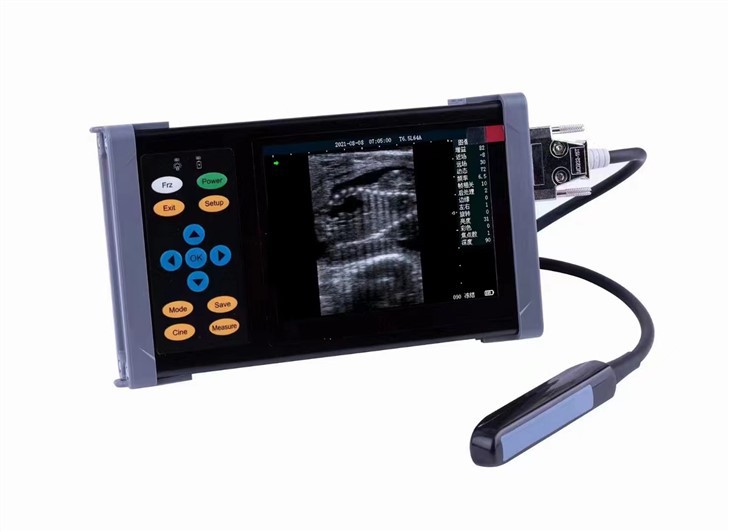
For example, our Equine Ultrasound Machine is engineered to balance power consumption and imaging quality. It uses advanced signal - processing algorithms to reduce power usage while maintaining high - resolution images. Our probes also come with energy - saving features, such as automatic shutdown after a period of inactivity, to further conserve battery power.
Case Studies
Let's consider a case study of a veterinary clinic that uses our portable ultrasound probes. The clinic frequently conducts on - site examinations of livestock, where access to power is limited. By using our low - power consumption probes, they were able to extend the battery life of their devices, allowing them to perform multiple examinations on a single charge. This not only increased the efficiency of their work but also reduced the need to carry additional power sources.
Another case involves a mobile medical unit that uses portable ultrasound probes for point - of - care diagnostics. The unit needed to operate in various locations, including remote areas and disaster - stricken regions. Our probes' energy - efficient design enabled them to use the devices for extended periods without relying on a continuous power supply, ensuring that they could provide timely medical services to patients.
Contact Us for Procurement
If you are interested in learning more about the power consumption of our portable ultrasound probes or would like to discuss your specific requirements, we encourage you to contact us. Our team of experts is ready to provide you with detailed information and assist you in selecting the right probe for your needs. Whether you are a veterinarian, a medical professional, or an organization involved in diagnostic services, we can offer solutions that meet your power - consumption and imaging requirements.
References
- "Ultrasound Physics and Instrumentation" by Richard K. Ziskin and John F. Lockwood.
- "Medical Ultrasound: Principles and Applications" by James G. Miller.